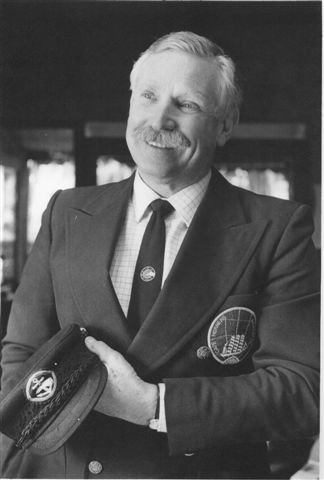
Mr Robert Leslie RUSSELL
- Born: 29 Jun 1926, Adelaide, South Australia
- Marriage (1): Ms Rosalind TAPPLY on 15 Sep 1951 in Adelaide, South Australia
- Died: 15 May 2005, Sydney, New South Wales, Australia at age 78
 Cause of his death was Lewi Body (Pneumonia). Cause of his death was Lewi Body (Pneumonia).

General Notes:
ROBERT LESLIE RUSSELL
By Jenetta Russell (Daughter)
Men of the sea and of agriculture have historically had much in common. Robert Leslie (Bob) Russell, who has died at the age of 78 after a long illness, managed to combine both in a very full life.
Born in South Australia, Russell grew up at Brighton near the beach, engendering his love of water and 'things maritime' from a very early age. After excelling in sports at school, Queen's College, gaining his 'blues' in Athletics, cricket and football, he joined the Navy in 1943 at the peak of WWII training at Flinders Island Naval Base. As a signalman he served North of Australia on Goode and Booby Islands before joining the Corvette minesweeper, HMAS Deloraine and being personally involved with the removal of many mines. This was often achieved by either shooting the mine with a rifle or rowing over to the mine, attaching an explosive charge, and (once clear) detonating.
In 1947 he went ashore, was demobbed and joined Elder Smith Goldsbrough Mort; however 18 months later, the call of the sea was too strong, taking up an offer to join the four-masted barque, S.V. Passat on its last voyage round Cape Horn and on to Europe carrying grain from the grain belts of York Peninsular in South Australia. This was the end of the era of merchant sail as costs required for new safety regulations onboard made it uneconomic compared with steam. Russell signed on as “Donkeyman”, helmsman and (officially) Ordinary Seaman - they sailed away in June 1949 carrying 4,500 tons of barley. The voyage took 110 days sighting land once only (Cape Horn) on the entire voyage.
Life aboard these last windjammers was pretty Spartan - no different to 100 or even 200 years earlier. Their Navigation aids (the sun, the moon, the stars and a sextant) were the same - they didn't have engines and relied on wind in sails alone.
The crew was divided into 2 teams, a Port and a Starboard watch. Watches were 4 hours with each watch working alternately. However, if you hadn't finished your job at the end of your watch, you kept working…. even if this meant continuing on through the next four hours and going back onto your next watch. Russell loved every minute of it, the harder it got the more he loved it - his enthusiasm emanates from every page of his log!
“Splicing the Mainbrace” or a tot of rum - as much as you can drink in one swallow was the Captain's reward for hard labour in extreme conditions such as they experienced down at Cape Horn and off the Antarctic. This excerpt from his log is an example of what befitted this reward:
“At 4AM three whistles [means all crew on deck] and had to get in Fore Upper Topsail when we should have gone below. ….. Finished at 5AM and down below into bunk. Got to sleep at quarter to 6 and was awakened at 6 AM and on deck once more as the four course had blown out. Finished this job of furling at 7.30 and down for breakfast and on to wheel at 8AM. Off wheel at 9.30 and then Jack and I had to get some wire strops that were hanging over the side from the four course, inboard … Then up aloft for one and a half hours putting new rovings on the main topsails. Boy was it cold. It was snowing and hailing most of the time and the yards and stays were covered with ice. Very thankful to get below. Its amazing how when working aloft all thought of cold and tiredness disappear and when on deck after it you feel warm all over. Off watch at 1 PM head down and just thinking of turning in at 2.15Pm when three whistles once more. This time to furl main and mizzen topsails……Finished at 3.30 PM a tot of rum from Captain and down into bunk and sleep till 6.20PM. Only 4 hours sleep in 44 hours and I'm not feeling particularly tired.”
Russell's brother, an electrical engineer, set up a Crystal set radio for him before “Passat” left South Australia, with an aerial rigged to the base of one of the masts so that music could be heard when off land. The Captain got to hear about this and asked if his radio could be attached to this aerial…. which was done! Voila! Music for the Captain too! Russell was presented with a bottle of rum that was duly shared round the mess. In due course, the rum ran out and mysteriously the Captain's aerial became unattached. He was called in to see why the Captain couldn't get music. As he was not into electrics (as his brother was), he made a good show of looking very seriously at the radio, lifting out the valves one at a time returning them quickly while he remembered where they went. A quick trip to the mast and re-attachment of the aerial quietly and, Hey Presto! The Captain had music once more and Russell and his mess another bottle of rum! This happened 3 or 4 times during the voyage (every time rum supplies ran low)……… At the end of the voyage he received his pay cheque - less 4 bottles of rum!
Russell returned to Australia on P&O's 'Strathmore' in 1950 where he met the children's hostess, Rosalind Tapply, who would become his wife and life-long partner. His arrival back in Adelaide marked the start of a career in the agricultural industry. From 1950 to 1967 he worked for the oldest agricultural machinery company in Australia, Horward Bagshaw Ltd rising to State Manager before being headhunted by Howard Rotavator, the originator of the rotary hoe. He was appointed as National Sales Manager but was quickly promoted on to the board as Sales Director. It was during this era that Russell became federal president of the Tractor and Machinery Association of Australia - being instrumental in turning the organisation into a political mouthpiece and focal point of the Australian tractor, farm and construction machinery industry. In 1983, Russell left 'Howards' and, with his son and daughter, started 2 agribusinesses, importing and distributing glass-fused-to-steel tanks and silos for agriculture and industry and also agricultural consumables and additives for feedmills and intensive animal production. His commercial and sales experience helped to take those companies to where they are today.
Being one of the last Cape Horner's (there are now only approximately 100 left in the world) has meant 50 years of camaraderie and friendship with hundreds of others who rounded the Horn under merchant sail prior to 1949, through the global organisation of Cape Horners (Amicale de Cap Horniers), meeting annually up till 2003, somewhere in the world. In 1988 at the instigation and organisation of Russell, the Cape Horners World Congress was held in Sydney around Bicentenary Day, January 26th, where the group were given Clarke Island on Sydney Harbour to view the momentous and historic spectacle of boats and ships - as President of the Australian section of Cape Horners, he was also a member of the Sydney Harbour Bicentennial Authority and for organising the event, awarded an Australia Day medal.
Through his work and Cape Horner interests, Russell travelled to many remote parts of the world regularly up until 2000, A highlight in recent years was a return to Cape Horn in 1991 as the guest of the Chilean Navy for the unveiling of a memorial to those who lost their lives in that treacherous piece of water. On the day of the unveiling the sea was so calm, Russell was quoted in the British press as saying he was pleased his family were not present as he had been telling them stories for 50 years about how rough the waters in that region were normally.
An enthusiast to the extreme, Russell was also a true gentleman and popular in all the walks of life his path took him. He will be sincerely missed by many who knew him. Russell is survived by his wife, Rosalind, and a son and daughter, Chris and Jenetta.
Noted events in his life were:
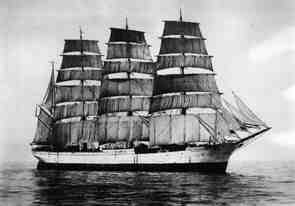
1. S.V. Passat which Bob sailed to England on in 1949.
Bark (4m).
L/B/D: 322 × 47.2 × 22 (98.1m × 14.4m × 6.7m).
Tons: 3,091 grt.
Hull: steel.
Built: Blohm & Voss, Hamburg; 1911.
A sister ship of Peking, Passat ("Trade Wind") was built for the nitrate trade between Chile and Europe. A fast ship, in her four voyages before World War I she averaged seventy-nine days out to Valparaiso, and ninety days back. Held at Iquique during World War I (with her running mate Parma, in 1921 she was surrendered to France as reparations only to be sold back to Laeisz at the end of the year. Resuming her old trade, during the 1920s she was involved in two serious accidents in the English Channel: in 1928, she rammed and sank the French steamer Daphne, and the following summer she collided with another steamer. In both instances, she was forced back to Rotterdam for repairs.
The depression and the development of synthetic fertilizers made the nitrate trade unprofitable, and in 1931 Laeisz sold Passat to the Åland Island ship master, Captain Gustaf Erikson. Under his flag she took part in the grain races between Australia and Europe through the start of World War II. In 1949, she and Pamir sailed from Australia to Europe for the last time, a passage recorded in Holger Thesleff's Farewell Windjammer. Sold to German interests for use as a merchant-training vessel, she sailed between Argentina and Europe with grain. Withdrawn from that work in 1957, she has been preserved as a floating camp at Lübeck since April 1966.
Rohrbach et al., FL: A Century and a Quarter of Reederei F. Laeisz. Thesleff, Farewell Windjammer.
Footnote
Bob may have been unaware of it at the time but by sailing to England around Cape Horn on the Passat in 1949 he became one of the last of the "Cape Horners" (extensively covered in Jenettas Obituary above). The reason is that to qualify you needed to crew on a vessel similar to the Passat. These ships were effectively banned from plying this trade after the 1940s due to safety concerns - a major one being that they relied on sail alone and did not have motors.
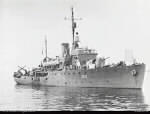
2. Military Service - Navy 1943-1947.
Bob serverd on the minesweeper corvette HMAS Deloraine from 1943. This corvette had already seen much action and had gained notoriety as the first Australian ship to sink a Japanese Submarine. The Deloraine was credited with sinking the I-124 off Darwin in January 1942. The story of this action appears below.
HMAS DELORAINE Details
Built by - Morts Dock, Sydney NSW
Laid Down - 19 March 1941
Launched - 27 July 1941 by Dame Mary Hughes, wife of the Navy Minister
Commissioned - 27 November 1941 under the command of Lieutenant Commander Desmond A Menlove RANR (S)
Sank a Japanese Submarine 1-124, off Darwin, 21 January 1942 but was damaged in the bombing of Darwin a couple of weeks later. Worked on East Coast Convoys and later in New Guinea.
Sinking of the Japanese submarine I-124 (see photo below)
On 20 January 1942, US Destroyers "Edsall" and "Alden" located Japanese submarine I-124 about 60 miles west of Darwin. They attacked I-124 with an intensive depth charge pattern but had no conclusive proof of any damage. The 3 Australian corvettes "Deloraine", "Katoomba" and "Lithgow" were ordered to assist with destroying the Japanese submarine.
"Deloraine" arrived in the area on 20 January 1942 and at 1.35pm her starboard lookout reported "Torpedo approaching green 100". Commander Desmond Menlove immediately ordered the helm to starboard and full speed on the engines. The tactic worked and the torpedo missed its mark.
3 minutes later, using asdic, "Deloraine" located I-124 about 2,500 yards ahead. Another 5 minutes later she laid down a diamond pattern of 6 depth charges. Bubbles of air and some oil bubbled to the surface. At 1.48pm following 2 more depth charge attacks, Japanese submarine I-124 blew to the surface but almost immediately dived below the surface, never to be seen again on the surface.
"Lithgow" and "Katoomba" arrived later in the afternoon while "Deloraine" headed for Darwin for more depth charges. It rejoined the others again by 3.05am the next morning. Another asdic contact was made and after more depth charge attacks, "Deloraine" claimed it had destroyed 2 Japanese submarines, while "Katoomba" had also claimed another Japanese submarine.
Later that day a diver from the Fleet Repair Ship "USS Black Hawk" located the wreck of Japanes submarine I-124. He could hear survivors tapping on the hull. No evidence was ever found of the two other reported submarine "kills".
Lieutenant Bruce Johnston Harvey (RANVR) of HMAS Deloraine, was awarded a DSC for his "skill and resources in HMAS Deloraine when the Japanese submarine I-124 was destroyed off Darwin on 21 January 1942."
Able Seaman Carson Jefferson Taite (RANR) of HMAS Deloraine, was awarded a DSM for his "skill and resources in HMAS Deloraine when the Japanese submarine I-124 was destroyed off Darwin on 21 January 1942."
Japanese submarine I-124 had laid 27 mines in the waters near Darwin earlier in January 1942.
REFERENCE BOOKS
Firkins, Peter, "Of Nautilus and Eagles - History of the Royal Australian Navy", Cassel Australia,1975
Worledge, G.R., "Contact! - HMAS Rushcutter and Australia's Submarine Hunters 1939-1946", The Anti-submarine Officer's Association, 1994
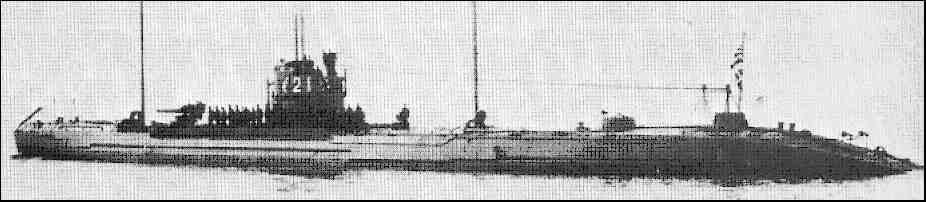
3. Submarine I-124.
4. God Father: Bob was Godfather to Frank Classen Best (Son of Midge and Tom).
Robert married Ms Rosalind TAPPLY on 15 Sep 1951 in Adelaide, South Australia. (Ms Rosalind TAPPLY was born on 5 Jun 1921 in England and died on 25 Jul 2009 in Sydney, New South Wales, Australia.)
|