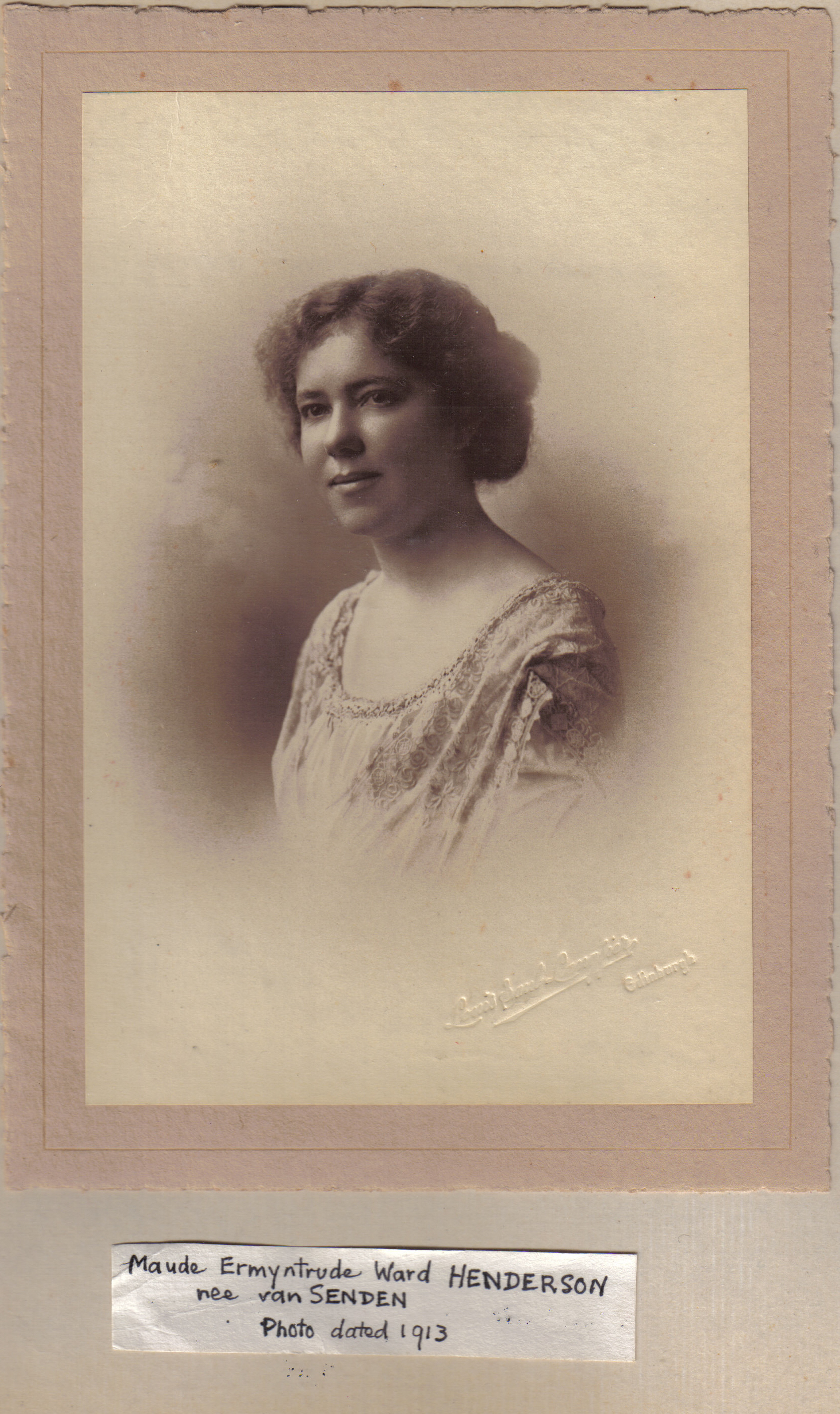
Ms Maude Ermyntrude Ward VAN SENDEN
- Born: 8 Nov 1889, Medindie, South Australia
- Marriage (1): Mr Rupert Isaac Koeppen HENDERSON on 2 May 1923 in St Peters, Adelaide, South Australia
- Died: 26 Sep 1987, North Adelaide, South Australia at age 97
 FamilySearch ID: LVN3-1F4. FamilySearch ID: LVN3-1F4.

General Notes:
MEMORIES OF ERMYNTRUDE HENDERSON (nee Van Senden)
Born 8 November 1889
One of my early recollections is of Queen Victoria's Diamond Jubilee, when a silver medal was struck for children. I was named Maude Ermyntrude Ward (Maude after my mother),
and Edith Maude; Ermyntrude because she liked and chose the name; Ward after the family name of rny paternal grandmother.
My brothers were Dudley Luto ( after our paternal grandfather) born 7 June 1892; Edward
Arnold ( Edward after our father) born 12 Novanber 1894; and Raymond Redvers, born 2 March, 1900. Elma Henrica was bom at "Ravens croft" Walkerville, on 29 July 1904.
Our home, "Dudley -Cottage", in Hawkers Road , Medindie, was a ten-roomed house. We had a cook, housemaid, nurse girl (daughter of Brigid the cook) , and later a nursery govemess, Rose Taylor, who slept in our nursery. When a little older, I slept in the day nursery, where we played, ate our meals, etc.
The house had a long central passage with a swing door (the upper half of coloured glass) which closed off the front rooms, and gave us easy access at the side and through the kitchen, sitting-dining area.
The grounds were spacious, with tennis court and lawns, an area planted with orange and lemon trees, and behind t e house a brick workshop for my father, whose hobby was carpentry, as well as keeping pigeons.
There were also a harness room; a man's room with shower; wash-house and dug-out lavatories; a coach house for 2 vehicles; and stabling for 3 or 4 horses with a hayloft over the stables. Also there were paddocks for cow and horses \emdash possibly one and a half acres in all. A boy or man was employed to tend the horses, milk the cow and work in the garden.
I remember when we were first connected with a telephone; it was not a usual household component, The lighting was by gas jet. The bathroom had a wash basin built rather high, with a window opening outwards above it. The bath was concrete - perhaps 2 feet high - with a cold shower. Of course there was no hot water in the house, except from the large cast-iron fountain on the kitchen stove.
We children used a round tin bath in the nursery. I think that, much later, a gas water heater was put into the parlourmaid 's pantry, off which was another pantry where were stored jams and less frequently used food and drinks, which Mother doled out.
There was no inside toilet, but we used a bedside commode with chambers, emptied each morning by the housemaid. Deep drainage was connected about 1898 to outside toilets, with water flushing and a chain to pull, which were noisy. They were called water closets, but spoken of as W.C. The street lights were also gas lights, and the lamp lighter rode a bicycle round nightly to light them up.
The family always had horses and buggy, a victoria for Mother, and there was a pony and cart for us children to use.
There was a good house on the vineyard near Reynella, and later we could use this as a
holiday house and take our friends there.
Public transport was by horse-drawm tram cars, both single and doubledeck. There were boys, 16-18 Nears, I think, no uniform other than a red ribbon round their hat. In King William Road at "peak periods, morning and evening, an extra horse was stationed at the base of the hill and was hitched up to help pull the tram, up to North Terrace. The same thing happened for the steep pull in front of the Children's Hospital to North Adelaide. Electrification of the transport was started at the beginning of the century, and I think the first electric tram to Walkerville ran in 1904. North Adelaide, Prospect, Walkerville, Norwood, Unley and Mitcham were sone of the early routes in the outer suburbs shorter horse lines were retained for several years. It was an outstanding event when the electric system was opened to Glenelg. The railways continued to run trains on the one more northem line to Glenelg.
At the Buckingham Arms Hotel corner in Medindie were a grocer, a greengrocer and chemist shops. The grocer called weekly for orders, as did the greengrocer, and a meat cart also. Mother or the cook gave the orders to them, and these orders were delivered.
I cannot remember having my household duties. We had our school hours daily, and also our regular rest or sleep periods. Like all children, we built houses in pine trees in the garden and had our games, and invited friends to play with.
Guy Fawkes Day was an "Event". Father always gave us a display of fire balls, rockets, etc., and we asked our friends and enjoyed the event greatly. Father Christmas came down the chimney, and it was an excitement to hang our stockings or sox on the towel stands and wonderful to open our presents with our parents, fitting in times with their
attendance at Church. I cannot recall dinner and turkey being of importance at all.
Grandma Richardson, her daughters, Aunt Fanny and Aunt Amy (whose "special girl" I was), and her son, Uncle John when he returned from his Queensland sheep station at Cunnamulla, lived together on Mills Terrace, North Adelaide, and we drove across frequently to see them, and I to stay, On the route, in Hill Street, North Adelaide, was a house with the painted figures of two black boys which were used as horse posts for visitors; and they are still there in 1983, in spite of bad treatment by vandals.
We had contact with others of Mother's family, Her sister, Blanche Wien Smith, was married to a doctor in Clare; they stayed with us and we with them; and also her brother, Willie Richardson, and his family. Father owned a vineyard, which he celled "Emdem", near Reynella, and Uncle Willie worked it for him, The old firm of Reynella had wine cellars there, and only circa 1970 did they merge with another company, Our grapes went to the local cellars of Mostyn Owen.
Early in the century Uncle Willie and his family of 3 sons and 2 daughters went to Kimba, near Port Lincoln, and took up farming property. Dudley used to go there for holidays, and I also went once, during an especially hot summer. Water was very short, and milk and butter were difficult to keep, as there was no cellar. These two articles of food were suspended in the well above the water, which helped to keep them somewhat cool. Father was a wool buyer and had a business in the Southeast of South Australia, with an office in Adelaide. His business called for a lot of travelling to Europe. He bought South Australian wool for firms in England, France and Germany. He had two trips to America and for 12 years, each summer he went to New Zealand for the wool sales there. He also visited the South Australian sheep stations.
Thus, it fell to Mother to bring us up largely, and to arrange for our schooling, She was wonderfully capable, and a strict disciplinarian.
Romney sheep were bred and developed on the island of Rormey, in the Thames estuary, England. At the beginning of the 1900' s Father had a friend, Mr David Power, who had a property at Minarto, south of Farrell Flat, South Australia, As friends, they imported a few Romney Marsh rams and put them to Merino and other breeds of sheep to try to develop a good crossbreed wool for general purposes of fibre and sheep, Hence, Father bought the small block of land - 15 or 20 acres just beyond Tea Tree Gully, had it fenced with a fox-proof fence, and kept quite a small flock of sheep there. Mr Hill was the rnan he had on the place to watch and protect the property. Mrs Hill had "mental" attacks * but did the cooking, and Father used to love to go there for weekends and watch progress.
There was a cottage with 4 or 5 rooms, and a second two-room building with kitchen and room for them. When Father bought the property near Yarcowie and Terowie (which was, perhaps, approximately 2,000 acres) , he had some sheep already crossed and other sheep men were interested, such as Hawker, etc., and so the crossbreed was started in South Australia. The wool was longer and coarser than merino, but still a fine wool, I think.
In about 1896 my father travelled to Europe, and Mother accompanied him. Dudley and Arnold stayed with Uncle Willie and Aunt Harriet while they were away; and Aunt Amy took charge of me in Grandma Richardson's house. While there I went next door to share the tutress the 2 girls and 1 boy had. The girls were Gwen and Dot Adarnson, and were definitely older than my six years.
The elder girl painted well and married, and was known as Gwen Barringer. Contact was not kept up,
My first school was a "Dames School" kept by the Misses Minchin, whose brother was in charge of the Adelaide Zoo. Dudley and Arnold also attended this school until old enough to go to a boys' school run by Rev. Slaney Poole and his daughters. Later, they went to St. Peter's Collegiate School, and I locally to "Clanfaergal", of which a charming Irish lady, Miss Meek, was the Head.
During this period my paternal grandmother died, She and her daughter Henrica had lived in London, and it was decided that Henrica should come to live with us in Australia, With three boys and me, and another baby expected, our house in Hawkers Road was too small, and Father bought a two-storey 10 roomed house in Walkerville , which was much larger, and which he called "Ravenscroft". There we had four servants, with Nellie to look after Ray and Elrna, care for the linen, ironing, etc
Mother, who was a good pianist, taught me to play the piano at an early age, and when 8 years old, began violin lessons with Ethel Wyatt.
For my last year at school I went to "Lliss Martin's School" in Flinders Street, Adelaide. The curriculum there allowed time for homework, and I had much more time to give to music. I was then playing in the Elder Conservatorium Orchestra, my teacher being Heinicke, a German immigrant. Later I learned with Miss Nora Kyffin Thomas, who worked me hard and taught me much. Our education included dancing, attending concerts, sometimes the theatre, etc.
Dudley finished his schooling at a commercial school, Muirden College, and went into a Bank as a clerk. Later on he worked at "Yongala" a property for sheep. From there he joined the Army during
World War 1.
Arnold did some wool sorting and similar work; then went to England, and Father's cousin, Sir Edward Ward, arranged for him to join the York & Lancaster Regiment during lilorld War I.
During my teen years i was Confirmed at our church of St.Andrew, Walkerville, attended more mature classes, and was prepared to help charity efforts with my violin, fetes, etc. Mother organized a sewing group for the House of Mercy (for "fallen" women), and I was expected
to help. The group included Eveleen King and Mrs George Selth, whose husband worked for Father for years in his office. This was a regular weekly meeting, over 2 to 3 years, I judge.
At school I was styled a conscientious worker; and continued for some months of French talks with a Parisienne, Madame Waite, who was married to a master at St Peter's College. But I did not pursue other studies, except music. I knew the usual types of fancy and needlework, making some of my clothes, and knitting sox in wartime.
In April, 1913, I left with rny Uncle Otto Wien Smith and his daughter Daisy (Isabel) on a trip to Europe. I think we travelled 2nd Class on the "Orion" to Naples, While the ship was going through the Suez Canal we caught a train at Suez and went to Cairo, spent a day there and visited the Sphinx, Pyramids, the native quarter of the city, the Museum, the big Mosque made of alabaster, etc. We joined the ship again at Port Said. It was an unforgettable experience. We landed at
Naples and travelled to Rome, Florence (which I loved), Venice, Milan (where I developed measles and upset our itinerary for a week, and we had to miss the Riviera); then to Como, Lugano, Lucerne, along the Bernese Overland to Interlaken, Geneva, Paris, and to London. It was a
beautiful tour and most interesting, Uncle and Daisy went to relatives in London, and I to old friends of Mother, the Ivlisses Aste, in Norwood, near the Crystal Palace, where Mother had studied piano and won a scholarship. Unfortunately she could not make use of it, as the family had to leave England and return to Australia, on her father's death. The Richardson family had lived at Upper Norwood, quite close to the Crystal Palace, and we were able to contact the residents of their old
horne and visit the house, 2 or 3 stories, and overlooking a communal wooded garden from the rear. So interesting to see.
I joined my uncle and cousin again, and we spent 18 crowded days at Berner's Hotel in London, sightseeing the galleries, a day at Ascot races, theatres, and heard Caruso and Dame Nellie Melba in a Command Performance of "La Boheme" at Covent Garden in the presence of King George V, Princess Mary and Prince Edward of Wales. Then we went on a fortnight's tour of Norway, after which we parted company, and I did not see them again until my return to Australia.
I returned to Miss Aste in London; then north to Altringham, near Chester, where I spent a day -walked on the walls, and heard Evensong in Chester Cathedral. After visiting friends of Father at
Preston, I travelled on to Scotland, where I met Hilda Warren from Adelaide at a village on the moors; then to the Isle of Skye, where I joined Cousin Maxwell Sceales, and her daughter Hope, for 3 weeks (including lessons in Gaelic, which I hated) ; then on to their horne at Bonnyrigg near Edinburgh for 3 months \emdash autumn, walks, usual daily life, food, etc. They were very quiet and very kind.
Leaving them in November, I crossed to Friessland, to Emden, and stayed with Great Uncle Luto van Senden, his charming wife Gertje and daughter Johanne, for a week. Luto was the Harbour Master and took me to see some offices, and we walked. It was pleasant family life there. Then I travelled by train to Leipsich and stayed at Pension Ludicke for 4 months. Nora Kyffin 'Thomas lived th ere in Ethel Cooper's flat. Ethel was also a pianist from Adelaide, who had taught me for a
time. I had some violin lessons from ???? but the purpose of the visit was to listen to concerts and to speak German as much as possible (which was also a rule of the Pension). Johanne came
there for 2 to 3 weeks to study Italian, and it was a happy time. The weather was cold, but they flooded an 18 tennis court area, and when frozen it made a wonderful skating rink. I tried, with little success, to skate.
After the 4 months I went to Dresden for 3 days, then back to London, and caught a ship for Australia, returning only 3 months before the outbreak of World War I. In Germany I felt a strong anti-British feeling but, on learning that I was an Australian, they were anxious to learn all they could of conditions in that country, as they intended to conquor it and for many people to emigrate there. In Australia the feeling against many German settlers was very strong, and unfortuately
I was not allowed to make any connections with Germans, which meant I could not keep up my German language.
When World War 1 began in 1914, Dudley was on a sheep farm of Father's at Yarcowie, but enlisted, He developed pneumonia on the troop ship going to England, and was in hospital camp, Salisbury Plains, for a time. My cousin, Dr, Geoffrey Wien Smith, was there also, as anaesthetist to our Adelaide surgeon, Sir Simpson Newland. Amold also enlisted, through Father's cousin, Sir Edward Ward, in an English Regiment, the York and Lancaster. Ray, being too young to enlist,
continued his engineering Course at the Adelaide University, and graduated. There was much organized Red Cross and other forms of war work to which one gave help.
The servant question was very difficult during the War, and the Walkerville home too large, and it was sold. A house was bou€ht at Brighton for summer use, and we lived in a rented house on Lefevre Terrace, North Adelaide, for a short time.
My father was overworked with Dalgety & Company, who had bought his business and made him Head of the Company in Adelaide, Also, as a wool buyer and knovm to be so knowledgable about wool, he was an active member of Bowra, an organization for classing and buying Australian wool for the needs of the War. His health was overtaxed, and he died, after an operation, on 8th January, 1918. Mother rnoved then to Brighton with Ray, Elma and me. Elma had left school and studied piano under the cellist Harold Parsons, and later at the Elder Conservatorium.
I had an urge to become a nurse, and was training at the Adelaide Hospital. After 15 months I was sent to the infectious Ward, and caught Scarlet Fever. It was a serious attack and, while recovering
at home, soon after Father's death, I found I was needed there to help Mother, being a teenager, so did not retum to finish my nursing course. I always felt regretful, but it has been a help to me at times, especially when living on the farm after my marriage. I took up violin studies again, and did charitable work, as well as helping in the house.
Several years later I became very friendly with Rupert Henderson, brother of my good friend Vera. We became engaged in 1922, and were married at St, Peter's College Chapel on 2nd May, 1923. Rupert had purchased a farm at Hill River, near Clare, and had crops put in by a share farmer, and also traded in sheep, After our marriage we lived on the farm and he worked it.
We had three daughters born: Isabel Clare on 7th July 1924; Barbara on 14th February 1926; and Edith Margaret on 30th September 1928. My Aunt Blanche, who lived in Clare and whose husband was Dr. Otto Wien Smith, was wonderfully kind and helpful, and gave rnuch time and thought to us.
Rupert and I led a very quiet life while on the farm, which we named "Tallala" ( "on a hill" in the native language). He only had either a boy or a man to help him, and could not leave easily. It was
nine miles from Clare over a range of hills, and not an easy drive, especially when it was wet, as the road was not sealed for the last 2 or 3 miles to the farm, Our trips to the town were limited to about once a week, and we collected the daily papers then from the baker's shop. There was a good library, which gave me much pleasure, and one could always ask for a special book to be obtained from the Circulating Library in Adelaide. We were members of the Clare Tennis Club, and I
used to go into the local orchestra, conducted by Mr. Bishop, for periods.
In 1930 we were much affected by the Great Depression. Sometimes we had a car to traverse the nine miles to Clare for our shopping, and sometimes depended on horses.
Life became much easier on the farm after Mother had the telephone installed for us. The doctor (my cousin, Geoffrey Wien Smith) could be contacted. There was one occasion when I, Barbara and Margaret all had whooping cough together, in the depth of winter. Rupert managed to nurse and feed us wonderfully, though he had a bad cough, which was probably a mild form of the disease. I had a big operation in Adelaide, and Rupert managed alone, with a man on the place.
After some years, we were able to buy a radio, which kept Rupert in touch the markets, and we heard the news daily, and also good music or a talk occasionally .... but not like our modern radio.
We went to Church, when possible, at St. Barnabas, Clare, and Rupert was a Lay Reader and conducted services there and at other Churches in the Parish from time to time.
We did manage a few holidays from the farm. Mother took me on a cruise to Java, Bali and round the north of Australia, but I do not like ship travel.
On this occasion the girls were temporary boarders at "The Wilderness" School. Rupert went on a coastal cruise to Queensland, and I think that the Girls and I stayed with Mother. Mrs Clara Henderson, my mother-in-law, took a house once for us at Brighton, and we all managed a few weeks together there. We had several other summer holidays at Brighton, but these were after the harvest, and the girls had to attend school for the 2 or 3 weeks we were there.
I taught the three girls with the aid of the excellent Correspondence School system the Government organized. Then, when she was 7 and 8, Isabel went to the city, and lived with mother at Medindie for two years, attending "The Wilderness" School. Then she came home and continued with correspondence lessons with the others, until they went to the Clare Primary School and were weekly boarders in the town. As times improved after the Depression, we were able to send them, in turn, as boarders at St. Peter's Collegiate Girls' School in North Adelaide, which was run by the Sisters of the Kilburn Order, until their education was completed. Barbara won a Red Cross Scholarship and took the Almoner Course, paertly in Adelaide by correspondence from the farm, and partly in Melboume, as the end of the course was not available in Adelaide at that time. Isabel became a stenographer as, later, did Margaret. Their lives are recorded elsewhere.
In 1946, when father died, Rupert sold the farm and we bought Mother's house at 4 Arthur Street, Medindie, and lived there with the girls. In 1949 Barbara married James Rounsevell, an engineer with the Shell Company, and went first to live in Darwin, with later frequent moves to various capital cities. Isabel am Margaret each went with a friend to Europe. Rupert took up with bowls; and became Secretary of St. Andrew's Church Day School, in which he became very interested. He was also active in the Church, and was Warden for sorne years. I became interested in the Mother's Union of the Church of England and acted on the Diocesan Committee, and was Diocesan Secretary for two or three years. I was able to join in with the Elder Conservatorium
Orchestra again, which gave me much pleasure. I was a member of the Lyceum Club; aud also played bridge; and ran the home, of course.
By 1968 the girls were away from home. Ivlargaret spent three years in New Zealand and Melbourne , and then married Kenneth Milburn in 1965 and has lived in Melbourne since. Isabel joined the Department of External Affairs in 1960 was posted to Jakarta, Indonesia, where she rnet and married, in 1961, Leith Ramsay. This left Rupert and me alone and, as we were elderly, the daughters strongly desired us to become secure for our declining years, so we sold the house in Medindie and came to the Helping Hand Centre in North Adelaide in February, 1967. We were happy here in our double unit, but Rupert did not live long after the move, amd died quietly on 15th May, 1968. I have been happy here, and very well cared for since that time, and feel secure in my
future needs that I shell have to my end.
Postscript: Ermyntrude passed away on 26 Sep 1987.
Maude married Mr Rupert Isaac Koeppen HENDERSON, son of Mr William Hall HENDERSON and Ms Clara Emilie KOEPPEN, on 2 May 1923 in St Peters, Adelaide, South Australia. (Mr Rupert Isaac Koeppen HENDERSON was born on 28 Sep 1890 in St Peters, Adelaide, South Australia and died on 15 May 1968 in North Adelaide, South Australia.)
Noted events in their marriage were:
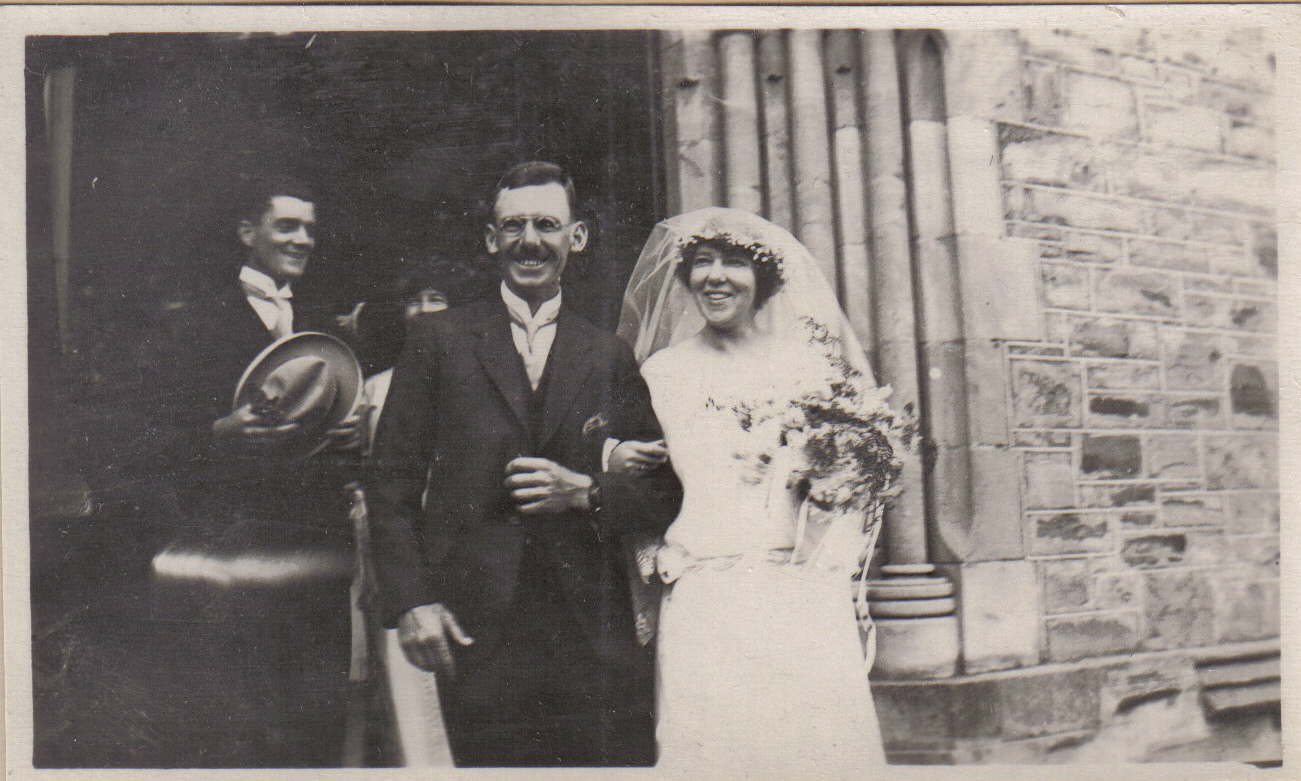
1. Marriage Banns, 2 May 1923, St Peters College Chapel, Adelaide, South Australia.
The bride wore a charming gown of ivory brocaded crepe de chene, with wide hanging sleeves of spider lace. The straight hanging frock was caught in with ruche of the same silk, giving long waisted effect. Tulle veil and wreath of orange blossom completed the tout ensemble. She carried a posy of white blossoms, not wired. Miss Daisy Wein Smith was bridesmaid in roseda and blue shot taffeta frock and black satin hat; her posy was of tea roses and autumnal leaves with frill of mauve. Mr Harry Downes supported the groom as best man.
Excerpt from the Adelaide Advertiser, 3 May 1923
|